
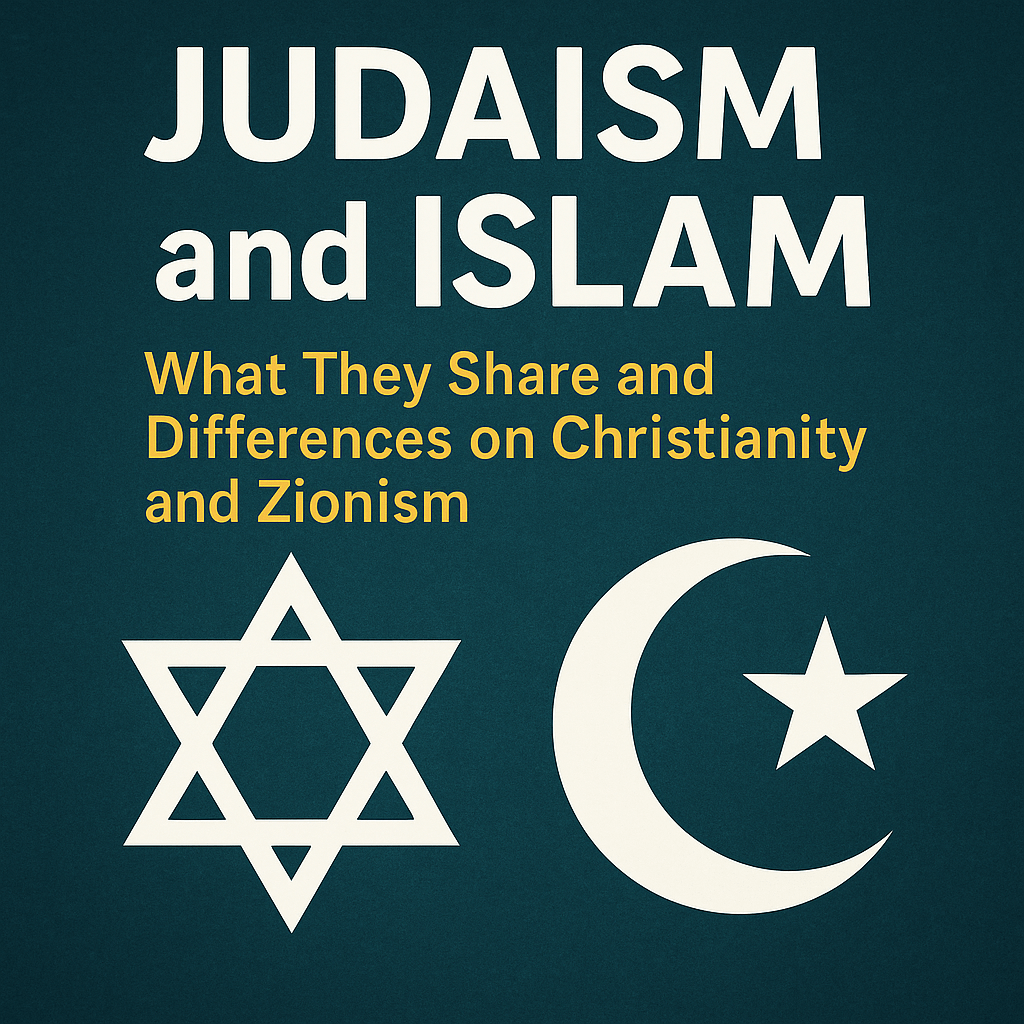
Common Ground Between Judaism and Islam
Judaism and Islam are two of the world’s oldest and most influential monotheistic religions. Despite their differences, they share a number of deep spiritual, cultural, and historical connections:
1. Belief in One God
Both religions strongly believe in monotheism—that there is only one God, who is eternal, all-powerful, and the creator of everything.
2. Prophets and Scriptures
• Judaism follows the teachings of prophets like Abraham, Moses, and others, as found in the Hebrew Bible (Tanakh).
• Islam recognizes these same prophets (Ibrahim for Abraham, Musa for Moses) and adds others, ending with Muhammad, considered the final prophet. Muslims follow the Qur’an, which they believe confirms earlier revelations.
3. Practices
• Both follow structured daily prayers, fasting (Ramadan for Muslims, Yom Kippur for Jews), charity, and dietary laws (Halal for Muslims, Kosher for Jews).
• Both emphasize community, family, and ethical conduct.
4. Jerusalem
Jerusalem is a holy city in both religions:
• For Jews, it’s the site of the ancient Temple and the heart of their historical homeland.
• For Muslims, it’s home to the Al-Aqsa Mosque, the third holiest site in Islam.
Views on Christianity
Despite sharing roots with Christianity, Judaism and Islam see it differently:
Judaism’s View of Christianity
• Jesus is not accepted as the Messiah or the Son of God in Judaism. He may be seen as a teacher, but not divine.
• Judaism rejects the idea of the Trinity and any claim that God became man.
• The New Testament is not recognized as a holy text in Judaism.
Islam’s View of Christianity
• Islam regards Jesus (Isa) as a prophet and a messenger of God, born of the Virgin Mary.
• Muslims believe Jesus performed miracles and was a significant figure—but not divine.
• The Trinity is rejected, and Islam teaches that Jesus was not crucified, but instead was taken to heaven by God.
• The Gospel (Injil), in its original form, is respected as a divine book, though Muslims believe it was later altered.
What About Zionism?
What is Zionism?
Zionism is a modern political movement, not a religion. It began in the late 1800s with the goal of establishing a Jewish homeland in what is now Israel.
It’s important to distinguish:
• Zionism ≠ Judaism. Not all Jews are Zionists, and some Jews oppose Zionism on religious or political grounds.
• Zionism ≠ a religious belief. It is a nationalist ideology, though it may draw on religious themes.
Islamic Perspectives on Zionism
• Many Muslims, particularly in the Middle East, oppose Zionism, mainly because of its connection to the Israeli–Palestinian conflict.
• The issue is more political than religious: opposition is usually to Israeli government policies, not to Jewish people or Judaism itself.
• Some Muslim-majority countries have normalized relations with Israel, showing a diversity of views within Islam.
Christian Perspectives on Zionism
• Some Evangelical Christians support Zionism, believing it fulfills biblical prophecy.
• Traditional Catholic and Orthodox churches have varied views, often focusing on peace and justice rather than political support.
• Like in Judaism and Islam, Christian opinions about Zionism vary based on politics, not doctrine.
Final Thoughts
Judaism and Islam are distinct but closely related faiths with shared values, ethics, and spiritual ancestry. While they each have their own views on Christianity, they agree on the importance of monotheism, scripture, and community life.
Zionism, meanwhile, is a modern political ideology that intersects with religion only partially and is often misunderstood. It’s crucial to approach the subject with care, recognizing the difference between religion, identity, and politics.
Follow us on social media: Unity Within

 The Path Of Light